

Introduction
Historically, the use of software has required businesses to input their requirements manually. The advent of AI agents has changed this by making it possible for software to understand objectives, use the proper tools, collect relevant information, and go through several steps in the workflow.
AI automation are different from standard chatbots since they can connect with business systems and execute certain functions. The latest agent systems are able to utilize various tools, maintain contextual awareness, adhere to the workflow, and act within established boundaries.
What Is an AI Agent?
An AI agent is a computer program containing an AI model as well as various instructions, information, and tools that assist the machine in executing certain operations. Depending on its design, it can interpret a user’s request, identify appropriate actions, find the needed information, etc. For example, while a normal chatbot is capable of suggesting the composition of the report, an AI agent has the ability to collect, assess, produce, store, and submit the report for signing. The main divergence is represented by the possibility to switch from communication to effective action.
Core Components of an AI Agent
An efficient AI agent comprises more than merely making use of an AI model. It consists of different parts that work hand in hand to carry out business functions error-free.
- AI Model: AI model interprets commands, analyzes the available context and elaborates a plan for fulfilling the task based on the information and tools acquired.
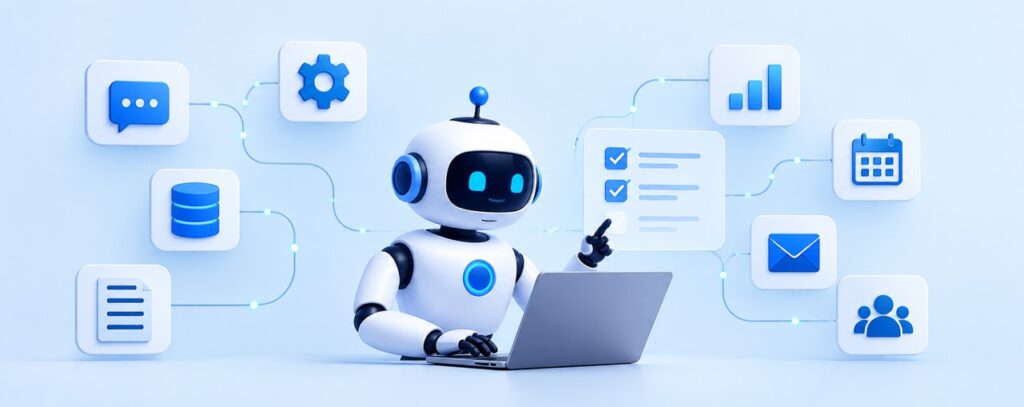
- Tools: Tools make the agent capable of communicating with external systems and fulfilling the available tasks. Depending on the business process established, these may include databases, CRM systems, email, calendars, internal APIs, search systems, and accounting software, among others.
- Context: The agents need proper information about the business matter, process, or customer. Providing useful information to the system contributes to the production of meaningful answers for the business.
- Memory or State: There are instances when tasks demand the need to store data over multiple phases or sessions. With memory or state, agents are able to store the necessary context to perform the various tasks.
- Guardrails: Guardrails specify what can be undertaken by agents. Such practices may result in limiting the availability of tools, data, and actions.
- Human Approval: In addition, in cases where an operation may require a lot of spending or influence many people, a human consent may be introduced by businesses.
Business Use Cases for AI Agents
In various departments within companies, AI agents can assist in areas in which tasks involving repetitive actions, several information resources or sets of processes can be performed.
Customer Support
AI systems can also obtain customer data, search files, check for common problems and generate replies for service teams. Consequently, this will help teams deal with essential tasks and let staff members work on more complicated situations.
Sal
Sales teams can use AI agents to research leads, summarize customer accounts, prepare outreach messages, update CRM records, and create follow-up drafts. These capabilities can reduce repetitive work across the sales process.
Financial Operations
AI agents can assist with tasks such as invoice processing, reconciliation, reporting, and information gathering. Sensitive financial actions can remain subject to approval and appropriate access controls.
Internal Knowledge
Workers can take advantage of AI agents to query information from the documents and internal databases approved for use. Instead of searching various systems, workers can now raise query questions and access connected business sources.
Software Operations
Tech teams can use AI agents to look through logs. They can also recap what happened during an incident. The agents may point to the key details and help with day to day work. This includes tasks tied to both building software and running systems.
Data Analysis
The agents can pull data only from approved places. They then sort through what is available and make a clear write up. This helps with work that repeats often, like reviewing the same kinds of data.
Single-Agent vs Multi-Agent Architecture
Not every business needs a complex multi-agent system. A single focused agent may be sufficient when the system needs to perform one clearly defined workflow. For more complex processes, multiple specialized agents can work together. For example, a coordinator agent could manage the workflow while separate research, data, reporting, and quality-check agents handle specific responsibilities.
The right architecture depends on the workflow. Adding more agents can also increase system complexity, so businesses should use a multi-agent approach only when it provides a clear operational benefit.
Security Considerations for AI Agents
Connecting AI agents to business systems requires careful security planning. An agent should have access only to the systems, information, and actions required for its assigned task. Important controls can include authentication, role-based access, tool permissions, audit logs, encryption, data isolation, approval workflows, rate limits, and continuous monitoring.
Security becomes especially important when agents work with customer information, financial data, internal documents, healthcare information, or other sensitive business systems. Building these controls into the architecture from the beginning can help create safer and more manageable AI solutions.
What Determines AI Agent Development Cost?
There is no fixed price for AI development because every project can have different requirements, integrations, workflows, and security needs. The overall cost depends on how complex the agent needs to be and how deeply it must connect with existing business systems.
Number of Integrations
Connecting an AI agent with one CRM is significantly different from connecting it with multiple CRMs, databases, APIs, internal applications, and third-party services. More integrations generally require additional development and testing.
Workflow Complexity
A simple FAQ assistant usually requires less development than an agent that manages a multi-step operational workflow involving several systems and approval stages.
Data Infrastructure
Businesses with well-structured databases, APIs, and accessible information sources may require less integration work. Fragmented or legacy systems can require additional preparation and development.
Security Requirements
Enterprise, healthcare, and financial applications may require additional authentication, permissions, monitoring, compliance controls, and security measures.
User Interface
AI agents can operate through web applications, dashboards, mobile apps, chat interfaces, Slack, or internal business applications. The required interface can influence the overall project scope.
Monitoring and Evaluation
Production AI systems need monitoring, testing, evaluation, and ongoing improvements. These activities help identify issues and maintain reliable performance as business requirements change.
How Businesses Should Start with AI Agents
Businesses should generally start with one clearly defined and measurable workflow instead of trying to automate everything at once. A good starting process usually happens frequently, requires repetitive manual work, has clearly defined inputs, and produces a measurable outcome.
It is also useful if the workflow allows human review before important actions are completed. This gives the business an opportunity to evaluate the agent, identify limitations, improve the workflow, and establish appropriate controls.
Once the initial workflow delivers measurable results, businesses can gradually expand the system to additional processes and explore more advanced enterprise AI agents.
Final Thoughts
AI agents represent a shift from AI systems that primarily provide information toward AI systems that can participate in controlled business workflows. They can help organizations automate repetitive processes, connect information sources, and assist teams with tasks that previously required multiple manual steps.
However, successful AI agent development is not simply about making an agent as autonomous as possible. The focus should be on building a reliable system that understands a specific business process, has appropriate access to tools and data, follows clear rules, and provides measurable value.
Netleon helps businesses design AI agent architectures, integrate AI models with existing software, and build controlled AI-powered workflows around real operational requirements.
FAQs
What is AI agent development?
AI agent development involves building AI-powered systems that can understand tasks, use approved tools, access information, and perform defined business workflows.
How much does AI agent development cost?
The cost depends on the agent’s complexity, integrations, data requirements, security needs, interface, and ongoing monitoring requirements.
Can AI agents integrate with existing business systems?
Yes. AI agents can integrate with CRMs, databases, APIs, internal applications, communication tools, and other approved business systems.
Are AI agents secure for enterprise use?
Yes, enterprise AI agents can be designed with authentication, role-based access, permissions, encryption, monitoring, audit logs, and human approval workflows.