

Introduction
Artificial intelligence has completely changed the way software applications are developed and used in companies. Thanks to Software as a Service solutions that utilize AI technology, including customer service and automated business tools, an organization can experience improved productivity and provide better customer experiences.
There are many more aspects than simply embedding an AI model into your app if you want to create a successful AI SaaS product. There should be a well-thought-out strategy and appropriate technologies and architecture.
This article will take you through how to build an AI SaaS product in 2026, the key development phases to consider, and how Netleon can assist you in making your idea reality.
Key Benefits of Building an AI-Powered SaaS Product in 2026
Artificial intelligence-based SaaS solutions help businesses automate the process of executing repetitive tasks, processing data quickly, personalizing the experience for users, and enhancing the decision-making process. Report automation, smart search, digital assistants, and other artificial intelligence-based technology may increase the value of the software provided by businesses.
The usage of AI in SaaS might result in the development of new features in products, the offering of differentiated subscriptions, and improvement of business processes. The key thing is that the implementation of AI should have an impact on the operations of a company.
1. Identify a Business Problem
You should begin by determining what issue your product will assist users with. For example, this can be the delay in customer support, slow paper processing, lengthy reports or inability to search for necessary information in various businesses.
Conduct a market analysis, study your competitors and even speak with potential clients in order to find out problems they have and which can be resolved with your product.
Develop based on single product feature rather than trying to create everything at once.
2. Define Your AI Workflow
Once you identify the issue, establish how artificial intelligence can enhance the experience of the user. The most popular use cases in this regard include content creation, document summarization, smart search, recommendation, analytics, and business process automation.
Trace the sequence of the user’s interaction with the system up until the end result. Find out what data the artificial intelligence should have access to, how it should behave, and whether it requires any human validation.
For instance, in case of a writing assistant, AI should write some content that should be validated by the user, whereas in case of business automation, AI would require some human validation to perform critical actions. Clearly defining the workflow also helps determine the right approach to AI model integration and ongoing product maintenance.
3. Choose the Right AI Technology
Selecting the right AI architecture is essential for performance, reliability, and cost management.
- Generative AI: Helps create content, summarize information, and answer questions.
- Retrieval-Augmented Generation (RAG): Combines an AI model with relevant information retrieved from approved documents or knowledge sources.
- AI agents: Support multi-step workflows by using defined tools and processes to complete tasks.
- Predictive AI: Uses historical data to identify patterns, forecast outcomes, and support decision-making.
For example, retrieval-augmented generation (RAG) can help an AI assistant answer questions using company documents, while AI agents can support more complex workflows involving multiple steps.
There are many products that can utilize existing AI models using APIs instead of creating a new model from scratch. Accuracy, speed, data security, integration capabilities, and cost should all be considered in your decision-making process.
4. Develop a Reliable SaaS Platform
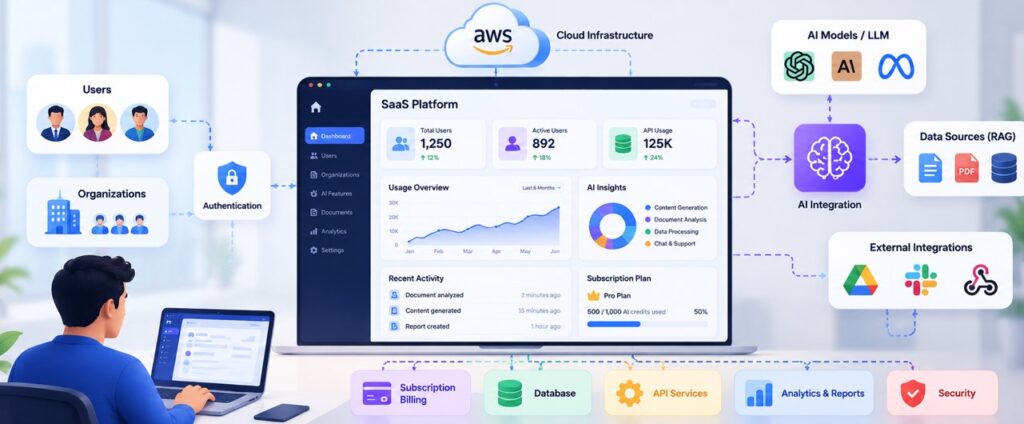
The AI-enabled product also requires a reliable SaaS product architecture, which could have features such as user registration, authentication, dashboard, database management, and subscription management.
In case there are several companies who will be using the platform, it is advisable to opt for a multi-tenant architecture to segregate data and permissions. This strategy will enable companies to offer services to many customers via one platform.
It is necessary to consider other features such as error handling, logging, quotas, and secure API integration. Such features contribute to a maintainable platform.
An experienced development team can help select suitable technologies and avoid unnecessary complexity. Explore Enterprise Software Development Services to learn how custom software solutions can support business requirements and product growth.
5. Plan AI Costs and Pricing
AI SaaS applications could have extra costs not only related to software development. These could be costs related to AI models, cloud services for hosting, storage, databases, monitoring, and third-party services.
Select a pricing strategy based on the value for customers and expenses on the side of the business. There are various strategies, including monthly subscriptions, usage-based, tiered, or hybrid subscription with limited usage.
Set up an AI usage tracking system to measure AI usage of customers and features. This will allow you to see which features are expensive to implement, manage usage limits, and calculate the cost of delivery.
Also, optimize prompts, choose the right models and caching of the suitable result, to avoid additional expenses for the implementation. Estimate the cost of serving each customer before launch and check the profitability of the business.
6. Test AI Performance and Reliability
AI outputs may differ due to instructions given by users, information available, and even AI models used. Hence, tests should include functionality and quality of generated outputs.
Make tests based on realistic scenarios of user needs. Check such factors as accuracy, relevancy, consistency, processing speed, and proper handling of ambiguous or incomplete instructions.
Following a step-by-step approach to evaluation of AI models will help you assess the quality of its outputs and find issues in advance. For those applications which work with company documents, check whether outputs are based on the source information. If your application has an automated workflow, make sure tasks are performed in the right order.
Continue monitoring performance after launch. User feedback and real-world usage data can help identify problems and guide future improvements.
7. Prioritize Security and Scalability
Security should be considered from the beginning, especially when an application handles confidential business information or personal data.
Implement appropriate authentication, role-based access controls, encryption, secure API key management, and data protection measures. Review the privacy and data retention policies of external AI providers before integrating their services.
Cloud infrastructure also plays an important role in application performance and reliability. As customer numbers increase, your application may require additional computing resources, storage, and AI processing capacity. Cloud Services can help businesses plan infrastructure, cloud deployment, monitoring, and cost optimization as their SaaS platforms grow.
Build with SaaS scalability in mind by choosing an architecture that meets current requirements while allowing individual components to scale as demand increases.
8. Launch an MVP and Improve It
A minimum viable product (MVP) allows you to test your idea without developing every planned feature upfront.
Include the essential user journey, core AI functionality, and appropriate security controls. Invite a small group of target users to test the product and provide feedback.
Measure indicators such as user activation, repeat usage, task completion, customer retention, and AI processing costs. Use these insights to improve workflows, refine AI prompts, introduce useful integrations, and adjust pricing.
A gradual launch helps validate market demand and reduces the risk of investing heavily in features customers may not need.
How Netleon Can Help You Build an AI-Powered SaaS Product
Building an AI-powered SaaS product requires expertise in AI integration, software architecture, cloud infrastructure, and product development. Netleon helps businesses turn their software ideas into practical, scalable, and secure digital solutions.
From planning your product requirements to developing custom features and implementing suitable AI model integration, Netleon can support your development journey. Our approach focuses on understanding your business objectives and selecting solutions that align with your users’ needs.
Whether you are launching a new SaaS startup or adding AI capabilities to an existing platform, Netleon can help you plan an MVP, streamline business workflows, and prepare your application for future growth.
With services covering AI and automation, custom software development, and cloud solutions, Netleon helps businesses build technology designed to improve efficiency and deliver measurable value.
Explore Netleon’s AI & Automation Services to discover how AI-powered solutions can support your business goals.
Final Thoughts
Making a successful AI-based SaaS product in 2026 is impossible without the perfect mix of business approach, technology, software development, security, and scalability. First of all, one should find the real pain point for customers and then find out the best way to solve it.
The process will include a specific use case, SaaS product architecture, performance of AI, and improving the product thanks to feedback from customers. A proper usage tracking of AI, SaaS product architecture, and cloud infrastructure may be helpful in reaching success in the future.
With proper development and technology partners, it is possible to turn business ideas into SaaS products with AI.
FAQs
1. How much does it cost to build an AI-powered SaaS product?
The cost will depend upon the complexity of the product, incorporation of the AI technology, security requirements, and the development time required. The cost of an optimized MVP should be lower than that of an enterprise application with lots of features. An accurate project evaluation will help you make a good estimate of the cost.
2. How long does AI SaaS development take?
The first MVP can be developed within weeks to months according to its complexity level. More complex applications using the advanced AI technology workflow and enterprise-level integration will take more development time.
3. Do I need to train my own AI model?
No. Many software applications have options to leverage existing AI models using APIs. In situations where there is a compelling reason to invest extra money, then you can do custom training or fine-tuning.
4. Which technologies are used to build AI SaaS products?
Your technology stack can include front-end and back-end frameworks, database, cloud platform, authentication service, billing service, and AI model APIs. It all depends on your product needs.
5. How can I reduce AI operating costs?
Pick the right models for each task, optimize the prompts, measure usage, cache the correct data, and minimize AI requests. Cost optimization analysis will ensure you maximize profitability.
6. Can Netleon help develop an AI-powered SaaS platform?
Yes. Netleon assists businesses in creating software solutions, integrating AI features and developing scalable applications that meet business goals.