
Modern websites are not just a matter of static layouts, images, text and graphic transitions anymore. The demand now lies in digital experiences of brands that come to life. Visitors of these sites are able to see responsive content; 3D product features and typography come to life and guide customers through the visual presentation of important information.
This approach is known as interactive website development.
The idea is to make use of motion graphics everywhere, everywhere to make interactive web experiences interesting and productive since motion design is just one of many means of conveying the message that should lead the audience to a certain action.
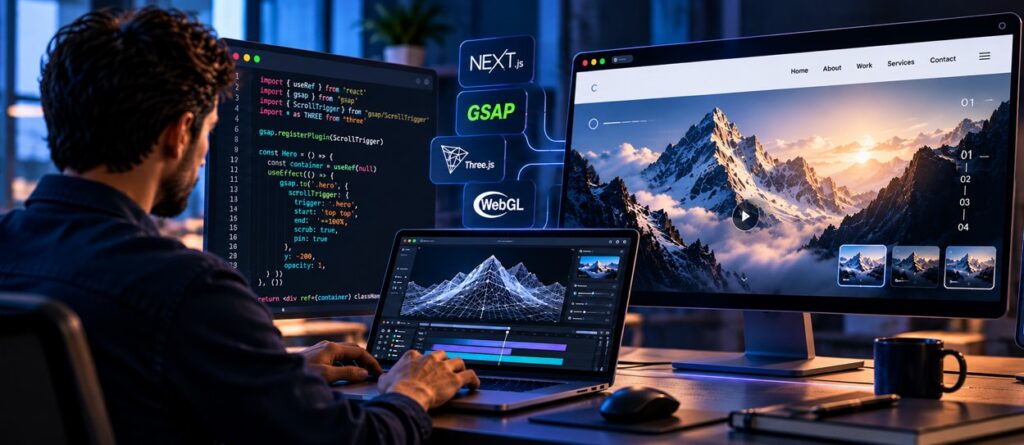
Various technologies, such as Next.js, GSAP, Three.js and WebGL have made it possible to create sophisticated websites. In modern world, users can enjoy different kinds of websites, such as interactive 3D environments.
What Is Interactive Website Development?
The process of interactive web development encompasses the creation of websites which have the ability to react when users act upon them.
This means that instead of just reading a web page from top to bottom, the visitor can also come across scroll-triggered animations, interactive demos of products, 3D techniques, animated text, interactions based on the user’s cursor movements, video transitions, parallax effect, animated background etc.
The basic principle is that all interactions must have a meaning.
Animations should facilitate the understanding and perception of information. 3D models should make a product easier to examine. Scroll animations should accompany the plot of the webpage rather than just add complexity to it.
Why Are Brands Moving Toward Immersive Web Design?
There are a large number of websites that users come across every day that are designed in a similar manner and have similar visual features or pattern. Hence, well thought out interactive web design is able to provide the brand with uniqueness in terms of their visual identity, thus making it easier for the customer to remember their product/service/idea.
Interactive web design is applicable mainly for technology companies, SaaS firms, luxury brands, as well as for innovative firms.
Using animated schemes, technology companies can visually show complex processes. SaaS companies can show the benefits of their services through interface of the product in the process of navigating through the page. Luxury brands can benefit from motion, typography and 3D graphics to make their web experience unique.
Technologies Behind Modern Interactive Websites
Next.js
Next.js is a framework based on React that can let users build contemporary production websites and web applications. It makes it possible to create websites that have advanced visuals while meeting performance thresholds owing to its routing, rendering features, image optimization and code splitting capabilities.
GSAP
GSAP serves as the go-to choice for advanced web animation, with the ScrollTrigger plugin that enables developers to synchronize animation timelines with the scrolling of the user. Such functionality allows developers to create components that are pinned, create scrolling animations, as well as produce parallax effects, and implement storytelling with timelines.
Three.js
Three.js is a framework for 3D graphics available in browsers that enables developers to create products, animate scenes as well as utilize camera movements.
WebGL
WebGL happens to be an API that makes interactive graphics rendering possible. The WebGL technology can be combined with other technologies allowing creating advanced 3D visualizations and web pages.
Scroll-Based Storytelling
Scroll storytelling is one of the most popular methods in modern interactive web design.
In scroll animation, scrolling is not just a means of navigation, as the user’s position in scrolling becomes an important part of the story. For example, a technology company talking about its infrastructure can utilize scroll storytelling.
As the visitor scrolls down, a server appears, applications start connecting with it, data comes along, and cloud solutions are introduced. Thus, the visitor can understand how different components relate to each other without being overloaded with text.
Such companies benefit a lot from the use of scroll animation for their product launches, web design agencies, and storytelling landing pages.
The Interactive Website Development Process
Creating an immersive website requires more than adding animations after the design is finished.
1. Discovery and Planning
The project starts with the business goals, target audience, content, user journeys and conversion objectives.
2. Interaction Strategy
The team determines where animation, scrolling, transitions and interactive elements can improve the experience.
3. UX/UI Design
Wireframes and visual designs establish the structure before complex interactions are developed.
For businesses that need a strong foundation for interactive experiences, professional UI/UX design services can help create user flows, interfaces and interaction systems.
4. Frontend Development
The approved experience is converted into a responsive website using technologies such as React, Next.js, JavaScript and modern CSS.
5. Animation and 3D Development
GSAP, Three.js, WebGL and other technologies can be integrated where they provide genuine value.
6. Performance Optimization
Images, videos, JavaScript, 3D assets and animation processes are optimized to reduce unnecessary loading and processing.
7. Testing and Deployment
The website is tested across devices, browsers and screen sizes before deployment and ongoing performance monitoring.
The Biggest Mistake: Animation Without Purpose
Adding animation does not automatically improve a website.
Too much movement can distract users, make navigation difficult, increase page weight, affect mobile performance and create accessibility problems.
Every animation should answer one question:
What does this interaction help the visitor understand or do?
If an animation does not improve communication, navigation, product understanding or engagement, it may not be necessary.
The best interactive websites are not necessarily the ones with the most effects. They are the ones where every visual interaction has a clear purpose.
Performance Matters in 3D Website Development
Large 3D assets, videos, textures, shaders and JavaScript libraries can significantly increase page weight and processing requirements.
Developers should consider:
- Image and video compression
- Lazy loading
- Code splitting
- Texture optimization
- Responsive assets
- Efficient animation loops
- Caching
- Device capability detection
- Reduced-motion preferences
- Optimized 3D models
A visually impressive website that takes too long to load can create a poor user experience.
Interactive Websites and SEO Performance
Interactive design and SEO should work together.
Developers should pay attention to page performance factors such as Largest Contentful Paint (LCP), Interaction to Next Paint (INP), Cumulative Layout Shift (CLS), JavaScript execution, image optimization and mobile performance.
Important content should remain accessible to users and search engines rather than being hidden entirely inside complex animations.
This is especially important for 3D website development, where large models, videos and visual effects can create performance challenges if they are not properly optimized.
Mobile and Accessibility Considerations
The mobile experience should be intentionally designed rather than treated as a smaller desktop version.
Some complex desktop effects may need to become simpler animations, touch interactions, static alternatives, reduced 3D scenes or shorter animation sequences.
Accessibility is equally important. Interactive websites should consider keyboard navigation, visible focus states, semantic HTML, screen-reader compatibility, accessible controls, appropriate contrast and reduced-motion preferences.
Where Interactive Websites Deliver the Most Value
Interactive website development can be particularly useful for:
- Product launches
- SaaS landing pages
- Startup websites
- Technology platforms
- Automotive websites
- Real estate projects
- Architecture portfolios
- Gaming companies
- Entertainment platforms
- Luxury brands
- Investor presentations
- Corporate storytelling
- Digital product showcases
The right implementation depends on the business objective, target audience and type of information being communicated.
Building Interactive Websites With Netleon
Creating a modern interactive website requires the combination of strategy, design, frontend engineering and performance optimization.
Netleon can combine modern web technologies with user-focused design to create websites that are visually distinctive while remaining scalable and practical for real-world users.
From frontend architecture and responsive interfaces to advanced animations, interactive experiences and backend integrations, the development process can be tailored around each project’s requirements.
Businesses can explore Netleon’s web development services for scalable websites and web applications designed around performance, usability and business requirements.
Final Thoughts
Interactive website development is transforming websites from pages people simply read into digital experiences people can explore.
The strongest experiences combine creativity with engineering discipline.
Motion should support storytelling. 3D should clarify products. Interactions should guide users. Performance and accessibility should remain priorities.
The future of web design is not simply about adding more animation or visual effects. It is about creating meaningful digital experiences where design, technology and storytelling work together.
FAQs
What is interactive website development?
Interactive website development creates websites that respond to user actions through animations, scrolling, 3D elements, interactive graphics and dynamic experiences.
What technologies are used for interactive websites?
Common technologies include Next.js, React, GSAP, Three.js, WebGL, JavaScript, HTML and CSS.
Are interactive websites SEO-friendly?
Yes. Interactive websites can be SEO-friendly when they have optimized content, fast performance, responsive design, accessible elements and proper technical SEO.
Can interactive websites work on mobile devices?
Yes. Interactive websites can be optimized for mobile with responsive layouts, touch interactions, lighter animations and optimized 3D assets.
How can Netleon help with interactive website development?
Netleon can combine UI/UX design, modern frontend development, animations, 3D experiences and scalable web technologies to build interactive websites tailored to business goals.