

Introduction
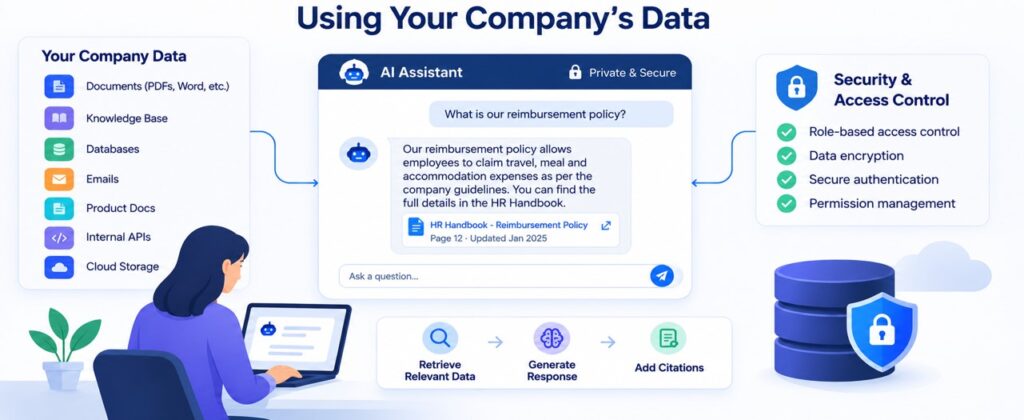
Companies have vast quantities of important details stored in a variety of formats, such as PDFs, company manuals, documentation, emails, databases, product instructions, and customer support materials. However, finding just the right piece of information in these documents can take more time than it takes to utilize the information.
An AI chatbot is a tool for end users who would like to get the needed company data without going through the hassle of searching for it manually or asking a colleague for it. All users need to do is ask the right questions
The utilization of advanced technologies, like Retrieval-Augmented Generation (RAG), allows for the creation of intelligent assistants based on the company’s specific data, which means that it is not necessary to create a new foundational model from the very beginning. The result is that business organizations now have the power to control their information access, ensure cybersecurity, and manage their data.
Key Benefits of Building a Private AI Chatbot
A private AI chatbot provides organizations with easier access to corporate knowledge and decreases the time employees spend on information retrieval. It can work with different information sources and produce accurate answers through the conversation.
Using AI typing, companies are able to enhance the productivity of employees, simplify customer support processes, make the internal knowledge manageable, and extract the needed data efficiently.
1. Identify Your Business Requirements
First of all, be specific in identifying the issues to be managed by your chatbot as well as its audience. For example, HR will have the staff members in need of easy access to policies, employees dealing directly with customers will need written material about the product and programmers will be searching for different kinds of technical advances.
Secondly, learn where your business store valuable information and which departments should get access to such data. You should also define what kind of questions are likely to be put by users and what responses they expect.
Finally, clarify the primary function of your chatbot in advance. It will be easy to understand what solution you have to build if you have already outlined its main purposes.
2. Organize and Prepare Company Data
The value of the data associated with your chatbot can impact directly its responses regarding their relevance and accuracy. Be sure to scan all the current company documentation at a pre-implementation stage.
There are important steps you should follow:
- Eliminate irrelevant documents from the current company archives.
- Find and remove identical entries.
- Keep the documents compete.
- Specify metadata such as document name, date, and department.
- Establish access rights for different users.
- Segregate business confidentiality data from common company information.
A solid AI knowledge base enables the chatbot to select only the relevant documents and limit the chances of utilizing old or nonsensical data in its answer generation.
3. Choose the Right RAG Architecture
Retrieval-Augmented Generation (RAG) is a commonly used approach for building private AI chatbots. It connects a language model with an external knowledge source, allowing the system to retrieve relevant company information before generating an answer.
The typical workflow looks like this:
User Question
↓
Search Relevant Company Data
↓
Retrieve Relevant Information
↓
Provide Context to AI Model
↓
Generate Answer
Split and chunks are the basic components of documents encoding that converts chunked parts of the text into numerical information called embeddings, which is then stored in an index using a vector database.
The retrieval process uses semantic or any other retrieval process to get the relevant data using the AI model.
Thus, organizations can utilize their own sources of knowledge written according to their specifications without having to build the foundation model from zero.
4. Implement User Permissions and Access Control
Security is one of the most important considerations when developing a private AI chatbot, particularly when multiple departments access different types of company information.
For example, HR employees may have permission to view employee records, while other employees should only access general company policies. The AI assistant must respect these existing restrictions.
Implement role-based access control (RBAC) and user authentication to ensure that employees can retrieve only the information they are authorized to access.
Authorization should be applied during retrieval, before relevant information reaches the AI model. This prevents the chatbot from exposing confidential content through generated responses.
A properly designed permission system should also account for changes in employee roles, access rights, and organizational policies.
5. Provide Answers with Source Citations
For business applications, receiving an answer is not always enough. Users should also be able to verify where the information came from.
A reliable private AI chatbot can provide source references alongside its responses, including:
- Document name
- Relevant section or page number
- Link to the original document
- Document date or version
For example, when an employee asks, “What is the company’s reimbursement policy?”, the chatbot can provide the relevant policy information along with a reference to the original document.
This makes responses easier to verify and helps users identify whether an answer is supported by approved company information.
6. Add Feedback and Continuous Improvement
A private AI chatbot should continue improving as business requirements and company information evolve.
Include simple feedback options that allow users to evaluate chatbot responses:
- Helpful
- Not helpful
- Report answer
Review this feedback to identify missing documents, irrelevant search results, and inaccurate responses. These insights can help improve document organization, retrieval quality, prompts, and model configuration.
Regular testing is also important. Evaluate how the chatbot responds to common questions, incomplete instructions, and queries for which the knowledge base does not contain sufficient information.
Continuous monitoring helps maintain answer quality and ensures the chatbot remains useful as the organization grows.
7. Prioritize Security and Data Privacy
Connecting AI with internal company information introduces important security and privacy responsibilities. Businesses should evaluate the complete system, including the AI model, data storage, integrations, and hosting environment.
Important security considerations include:
- Data Encryption: Protect information during transmission and storage.
- Authentication: Verify user identities before allowing access.
- Access Control: Restrict information retrieval according to user permissions.
- Data Retention: Define how conversations, documents, and retrieved information are stored.
- Activity Logging: Maintain appropriate records of system access and activity.
- Model Provider Policies: Review how external AI providers handle submitted data, retention, and model training.
- Regional Data Requirements: Consider applicable data residency and industry-specific compliance requirements.
A private chatbot does not automatically guarantee complete data privacy. Its security depends on the architecture, hosting environment, integrations, access controls, and policies implemented by the business.
Businesses can also explore Cloud Services to understand how secure cloud infrastructure, deployment, and monitoring can support their AI applications.
8. Select the Right Technologies and Launch an MVP
The technology stack depends on your chatbot’s complexity, data sources, security requirements, and expected usage.
A typical private AI chatbot may include:
- Large Language Models (LLMs): Generate conversational responses using retrieved company information.
- Embedding Models: Convert documents and user queries into numerical representations for semantic search.
- Vector Databases: Store and retrieve relevant document embeddings.
- RAG Frameworks: Coordinate information retrieval, context preparation, and response generation.
- Backend APIs: Connect the chatbot with databases, internal applications, and authentication systems.
- Cloud Infrastructure: Support application hosting, processing, storage, and scaling.
Instead of developing every feature at once, businesses can start with a Minimum Viable Product (MVP). Connect a limited set of approved documents, implement user authentication, and test the chatbot with a small group of employees.
Measure answer accuracy, retrieval relevance, response time, and user feedback. Use these insights to improve the system before connecting additional departments and information sources.
An experienced development team can help select suitable technologies and build an architecture that supports future expansion. Explore Enterprise Software Development Services to understand how custom software solutions can integrate with existing business applications and workflows.
Common Use Cases of Private AI Chatbots
Private AI chatbots can support different departments by making approved organizational information easier to access.
Employee Knowledge Management
Employees can ask questions such as “What is the reimbursement policy?” or “How many days of leave are available?” and retrieve relevant information from approved company documents.
Customer Support
Support teams can use an AI assistant connected to product documentation, help articles, and troubleshooting resources to find relevant answers more efficiently.
Sales Teams
Sales professionals can quickly retrieve information about product features, pricing documents, enterprise packages, and approved sales resources.
Technical Teams
Developers and IT teams can search deployment documentation, technical specifications, troubleshooting guides, and internal engineering resources.
Human Resources
HR teams can make onboarding documents, employee guidelines, benefits information, and internal procedures easier to find for authorized users.
How Netleon Can Help You Build a Private AI Chatbot
Building a private AI chatbot requires expertise in AI development, data integration, retrieval architecture, software engineering, and security. Netleon helps businesses turn their requirements into practical AI-powered applications connected to their existing business information.
From designing a Retrieval-Augmented Generation (RAG) architecture to integrating language models, databases, APIs, and document repositories, our team focuses on developing solutions aligned with your business needs.
Whether you want an internal employee knowledge assistant, an AI-powered customer support chatbot, or a customized enterprise AI solution, Netleon can help you plan, develop, and deploy a scalable application.
Explore Netleon’s AI Development Services to discover how custom AI solutions can improve information access, automate workflows, and support business growth.
Final Thoughts
It’s not enough to simply link your company data to a large language model to create a private AI chatbot for your organisation, you need to build a strong knowledge graph, information retrieval system, user rights management and security.
But if done correctly then this will make your organisational knowledge easier to find and keep your sensitive information secure. Using technologies like RAG, vector databases, semantic search and Role Based Access Control will form the foundation of your Enterprise level AI assistants.
With the right architecture and partner you can turn your company data into an intelligent knowledge system to provide support to your employees and customers.
FAQs
1. What Is a Private AI Chatbot?
A private AI chatbot is an Artificial Intelligence assistant that can answer questions by searching through your organisations internal documentation, databases, polices and other authorised sources.
2. How does the private AI Chatbot Work with my companies data?
Commonly the private AI chatbot will use a technique called Retrieval Augmented Generation (RAG) whereby the AI searches through the companys knowledge base it is connected to and finds relevant information related to the users query and feeds this into the AI model.
3. Do I need to Train My Own AI model?
No, businesses can use pre-trained Large Language Models via an API and use the RAG technique to link to their internal data. However, if you have specific bespoke needs within your business then it may be considered to train/ fine tune your own model.
4. Can the private AI chatbot search through PDFs and databases?
Yes, depending on how it is set up your private AI chatbot can search through PDFs, Word documents, Knowledge Bases, SQL databases, Cloud Storage, Support Articles and Internal APIs.


